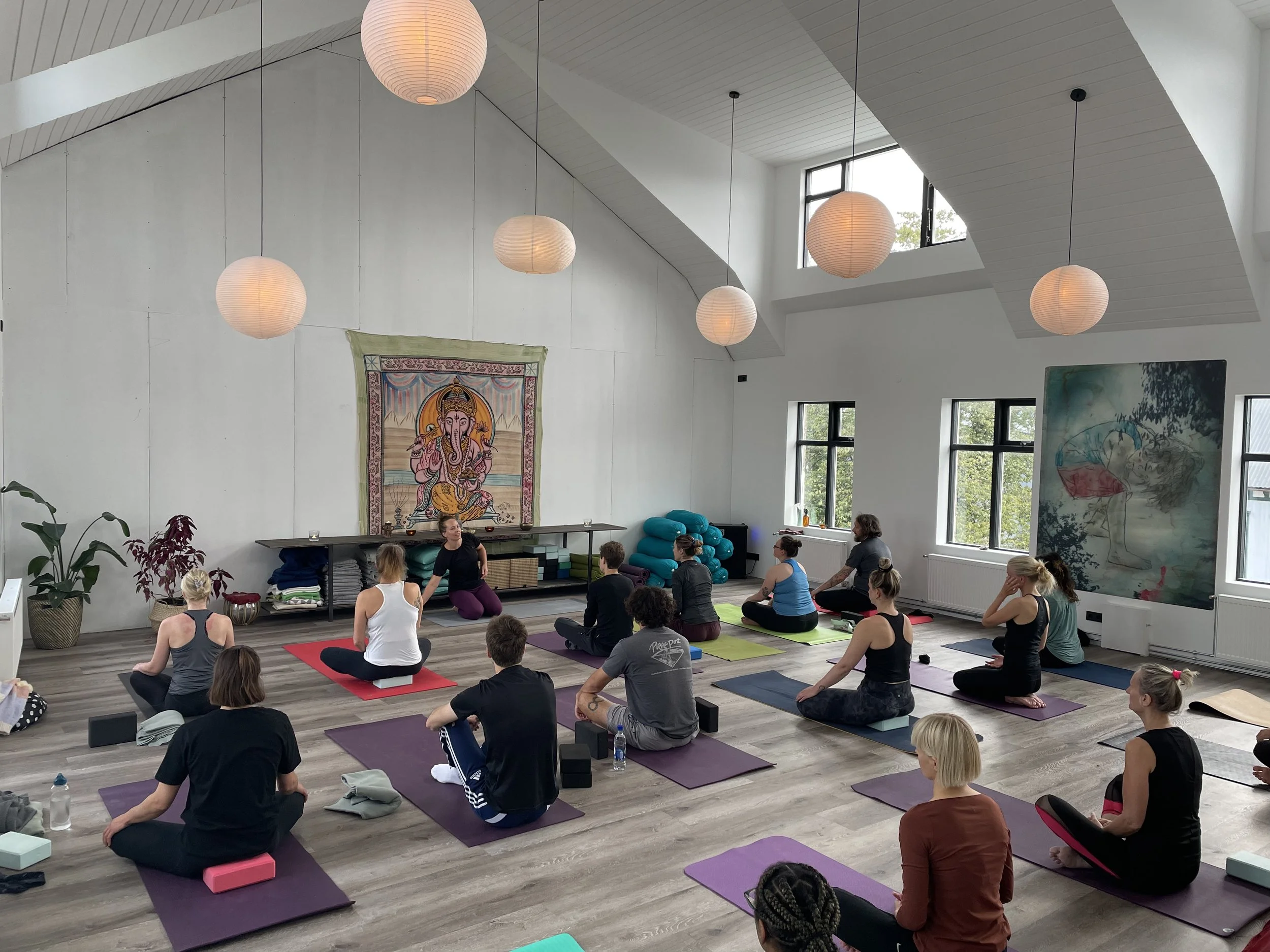
Every class, workshop and retreat is different, but they all draw from the same five elements.
Together they create an experience that is grounded in fascia science, guided by sensation and designed to support life beyond the mat.
The Practice
What do I teach
-
This practice encourages different kinds of movements - stretching, spiralling, rebounding and loading the body, in ways that support healthy fascia.
Your fascia is made up of collagen fibres suspended in a gel-like ground substance. Movement encourages these fibres to organise themselves along the lines of force they experience, helping your tissues become stronger, more adaptable and better able to transmit force throughout the body.
Instead of asking your body to fit a pose, I invite you to let sensation guide the movement. Movement becomes less about achieving a shape and more about creating a conversation with your body.
-
In the style of Yin Yoga, this practice uses supported, sustained stretches to give your body time to soften and you mind to fully connect to the moment through the body’s presence.
Fascia responds differently from muscle. While muscles often enjoy dynamic movement, fascia also benefits from slower loading that encourages hydration, adaptability and resilience over time. Emerging research suggests that slower, sustained stretching may also support healthy inflammatory processes within the fascial system.
By staying with a shape for longer, supported by props and the ground underneath you, without pushing or striving, you allow the body, and the mind, to gradually open. There is no forcing, only listening.
-
This practice uses therapy balls, foam rollers, soft balls or blocks to gently compress different areas of the body.
Fascia responds to pressure differently from muscle. Sustained compression encourages fluid exchange within the tissue, supporting hydration and healthy glide between fascial layers.
If you experience tight shoulders, an aching back or areas that feel stiff from sitting, stress or repetitive movement, learning simple self massage techniques, or Myofascial release, can be an empowering way to ease tension, manage pain and support more comfortable movement.
Slowing down enough to notice what changes before and after each technique helps you become more aware of how your body responds and what it needs.
-
This practice invites you to become still, supported and focus your attention inwards.
Your fascia contains an extraordinary network of sensory receptors that constantly send information to your brain about pressure, movement, position and internal sensation. Most of the time we hardly notice these messages because our attention is elsewhere.
By slowing down and resting in supported shapes, guided through breath, meditation or body awareness, you create the conditions to notice what is usually hidden beneath the noise of everyday life. You begin to recognise areas of ease and areas of tension, where your breath moves freely and where it doesn't.
This is where knowledge becomes experience. It is the foundation of every class I teach.
-
This practice explores the relationship between voice, vibration, expression and the body.
Every sound we make creates vibration. When we hum, sigh, chant or sustain a gentle tone, those vibrations travel through the tissues of the body, offering another way to experience ourselves from within.
Research is beginning to explore how vocal vibration may influence breathing, vagal regulation and our experience of internal sensation. More importantly, many people simply notice that sounding helps them soften, breathe more freely and feel more present.
Another way of listening...of releasing...of coming home to yourself.
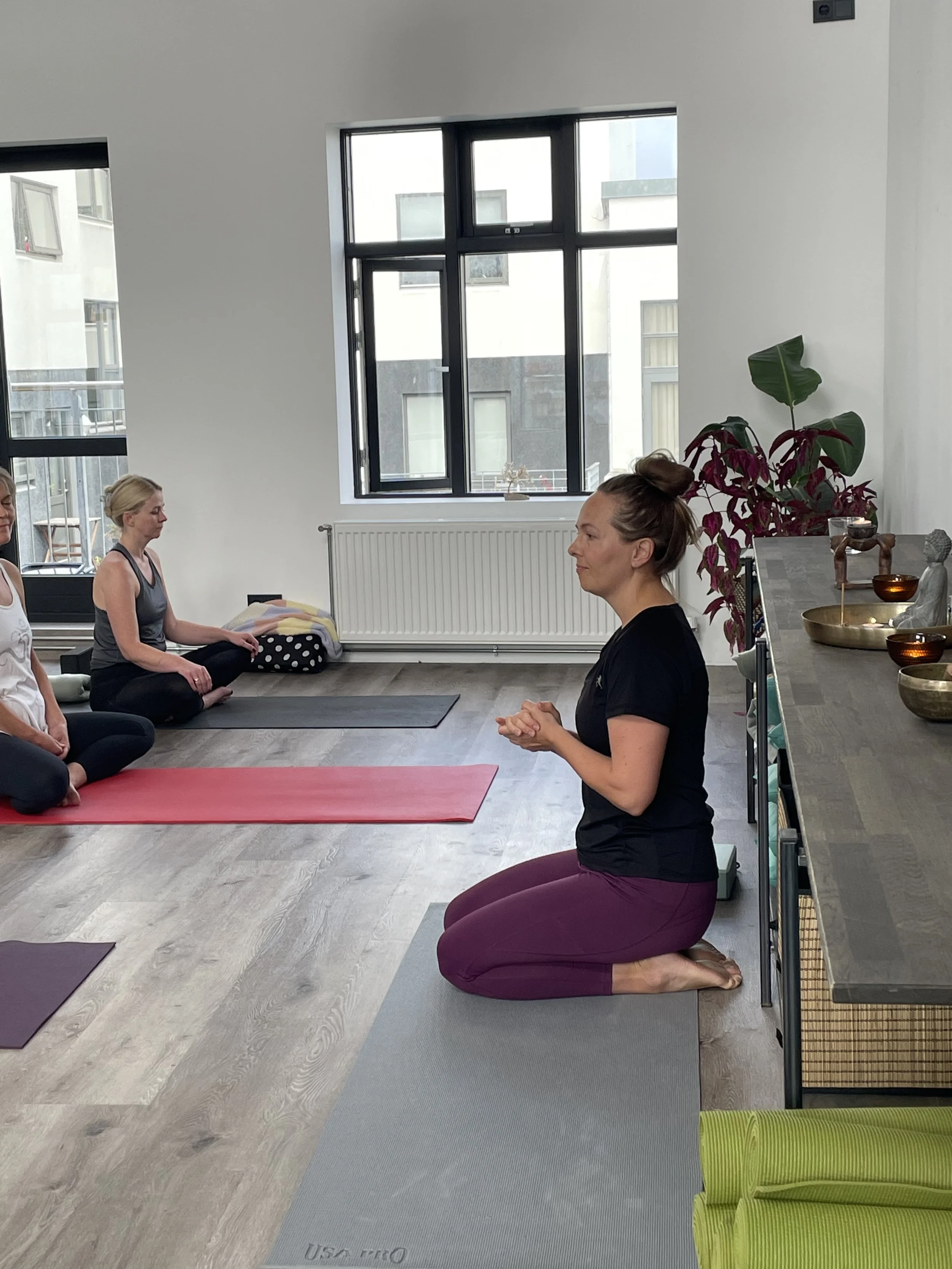

Feel it first hand…
-
Scientists define fascia in different ways, but I find the simplest way to think about it is to imagine your body with all it’s bones, muscles, organs and covered in skin - and what links it all together is Fascia. it is in your cells, around and in your muscles and bones, and it fills the spaces between everything, everywhere in your body. You can think of it as your body’s internal spiderweb - connecting everything to everything.
Until recently, fascia was largely overlooked and dismissed as mere “packaging” material. However, emerging research shows that fascia plays a vital role in how we move, feel and experience our bodies and the world around us.
Fascia is deeply connected with many of the body's systems, including our muscles, nervous system, circulation and lymphatic system. Because it reaches throughout the whole body, changes in one area can influence another, reminding us that the body is designed to work as an interconnected whole.
Learning how to work with your fascia can support easier movement, healthy mobility, resilience and overall wellbeing throughout life.
If you're interested in the research, the Fascia Research Congress describes fascia as: “A fibrous collagenous tissues where the structure is affected by tension and load”.
Another description could be “Fascia is a continuous web of connective tissue that surrounds and supports every muscle, bone, organ and nerve in your body.”
-
Until recently,Fascia was often overlooked as mere packaging and support material, but modern research keeps showing us how important it is in our overall physical and mental wellbeing.
All movement, like yoga, weight lifting and running incorporate certain properties of Fascia. But, targeting Fascia specifically has multiple benefits like:
Physically
Increase flexibility and range of motion by learning to stretch more affectively
Create more strength and resilience in your tissues for injury resistance and force transmission.
Facilitate rehydration to muscles and tissues in the body for overall wellbeing and function.
Nervous System Regulation
Increased Body Awareness
Manage inflammation and pain relief.
Mentally
Balance Stress and Overwhelm
Mindfulness
Increased Mental Resilience
Personally
Exercise your inner agency
Find creativity and freedom in movement and beyond
Deepen your knowledge of both body and mind, and how they communicate with each other
-
Rather than aiming for one ideal alignment, fascia-informed movement invites you to use sensation as your guide.
Rooted in Functional Yoga Integrated approach, this means that you will not be guided to place your foot specifically ‘here’, in relation to ‘there’ - but focus on where to feel the stretch/strength/compression in the area of the body being worked with.
In a class you could be doing:
Yoga shapes and flows
Jumping
Active stretching
Self massage with balls or roller
Breath awareness
Resting while listening to body guided meditations
Gentle voicing
Different themed classes invite you to explore different things but whatever it is, it is done with a slow mindful pace with time to check in and connect with what is happening in the moment.
Working with the different practices above, or a combination of them - the living intelligence of your whole body is being activated, through Fascia.
-
Absolutely!
I have had many people join my classes as beginners, and they have got on very well right from the start. The pace of all offerings is slow and the practices are tailored to fit all experiences.
If you are coming to my in person classes for the first time, I always like to check in with you before we start to see if you have any questions or how much experience you have, so I can support you in the right way.
I know that taking the first step onto the yoga mat can be nerve racking, so if you prefer to have a little chat before you sign up, do get in touch on info@stinuyoga.com
-
Not at all.
My teaching is guided by sensation rather than trying to achieve the "perfect" pose. This means that the practice is person centred as I believe that all bodies are unique, which means that everyone is going to look different in each pose, or shape, as I like to referred to them.
You will always be offered options, encouraged to move at your own pace and reminded that resting is just as much part of the practice as moving.
Understanding the Practice
-
I teach weekly in person at the Firhouse Community and Leisure Centre in Dublin.
I run regular workshops and retreats both in person and online.
You can join The Slow Space, my online space for practice and community dedicated to Fascia Focused Movement and exploration.
Head over to OFFERINGS for more information and to book in.
-
Yes, I do!
If you are intersted in a more personal exploration, or you want to work with something specific in your body - you can email me on info@stinuyoga.com.
-
What you need for your practice depends on what you will be doing.
Wearing comfortable clothing always helps wether you are moving or resting Having layers at hand to help you feeling snug while practicing, is also useful, like blankets and pillows.
Our Fascia network works best when it is well hydrated. Drink a glass or two of water before/after practice, or sip occasionally during.
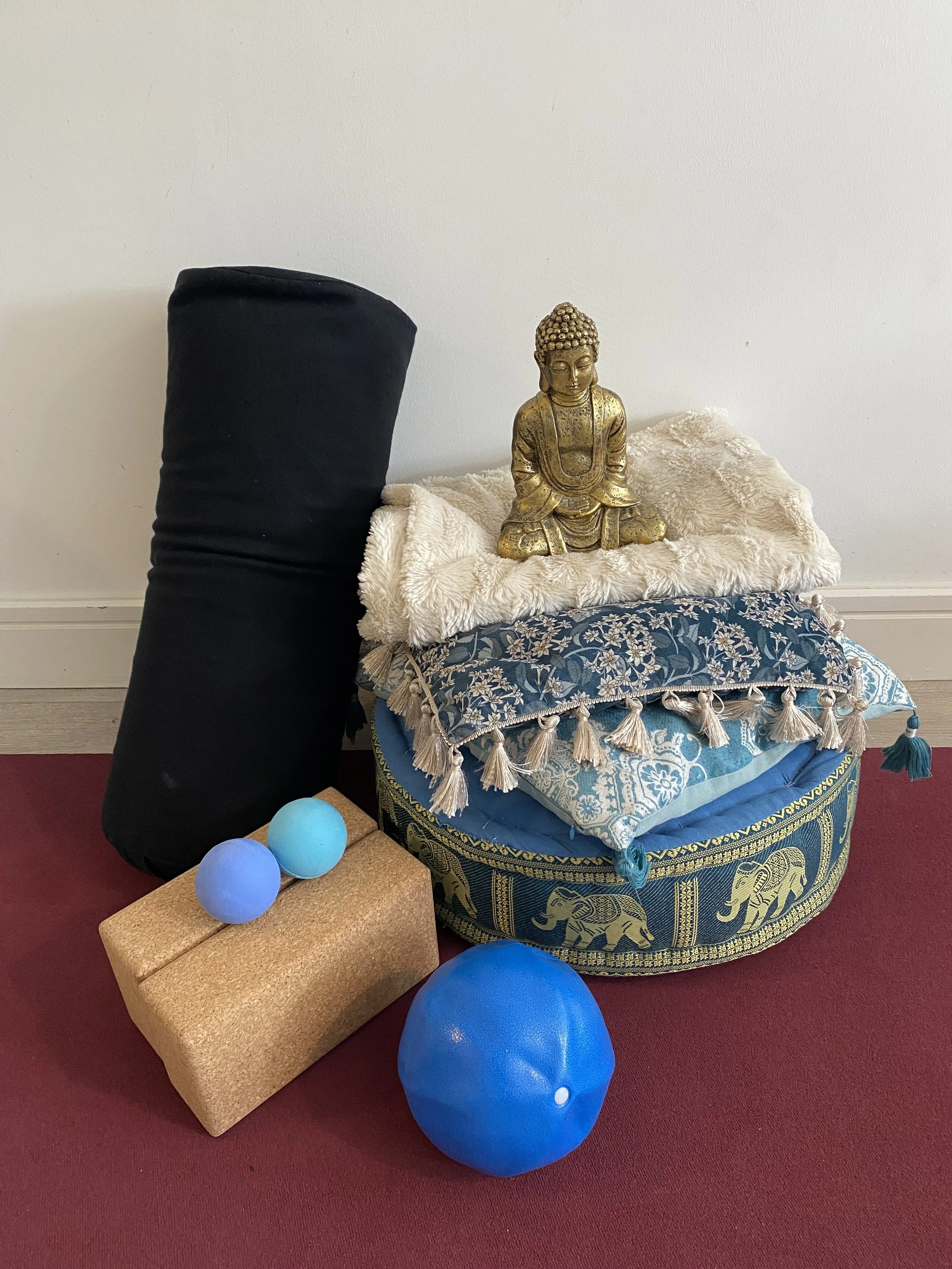
During ‘Release’ practices, we use a pair of therapy balls and soft pilates balls. Tennis balls can work well, but are a a little slippery. Cork balls are very firm so i recommend any balls that land in between those two.
During ‘Melt’ practice it is handy to have a a yoga bolster, but you can easily fashion on e at home by wrapping a pillow into a blanket.
Your essentials will be a yoga mat, or a comfortable surface, and two yoga blocks, that can be substitute with 2 thick books.
-
Many people join my classes because they are experiencing stiffness, tension or recurring aches.
While my classes are not a replacement for medical advice or treatment, they offer gentle, adaptable ways to explore movement, find release, manage pain and often complement rehabilitation.
If you are unsure, feel free to get in touch on info@stinuyoga.com before booking.
-
Most likely, yes.
Whether you are new to movement, returning after a break, living with an injury, navigating pregnancy or simply feeling the effects of a busy life, these practices are designed to meet you where you are.
I offer different options throughout every class and encourage you to move according to how your body feels, rather than trying to achieve a particular shape or keep up with anyone else. Rest is always welcome, and listening to your body is considered part of the practice, not a sign that you are doing less.
I am a qualified Pre and Postnatal Yoga Teacher, so many of my classes can be adapted to support you during pregnancy. If you are pregnant, recovering from an injury, living with a medical condition or you are simply unsure whether a class is right for you, I would love to hear from you on info@stinuyoga.com before you book. We can have a chat and find the practice that feels most supportive for you.